What "fight or flight" actually is
Your autonomic nervous system has two main branches. The sympathetic branch is the accelerator — it mobilizes you for action, releasing adrenaline and cortisol, raising your heart rate, and sharpening your focus onto threats. The parasympathetic branch is the brake — often called "rest and digest," it slows the heart, deepens digestion, and allows repair. You need both. The problem is not that you have a stress response. The problem is that, for most people, the accelerator is pressed lightly all day long and the brake is rarely touched.
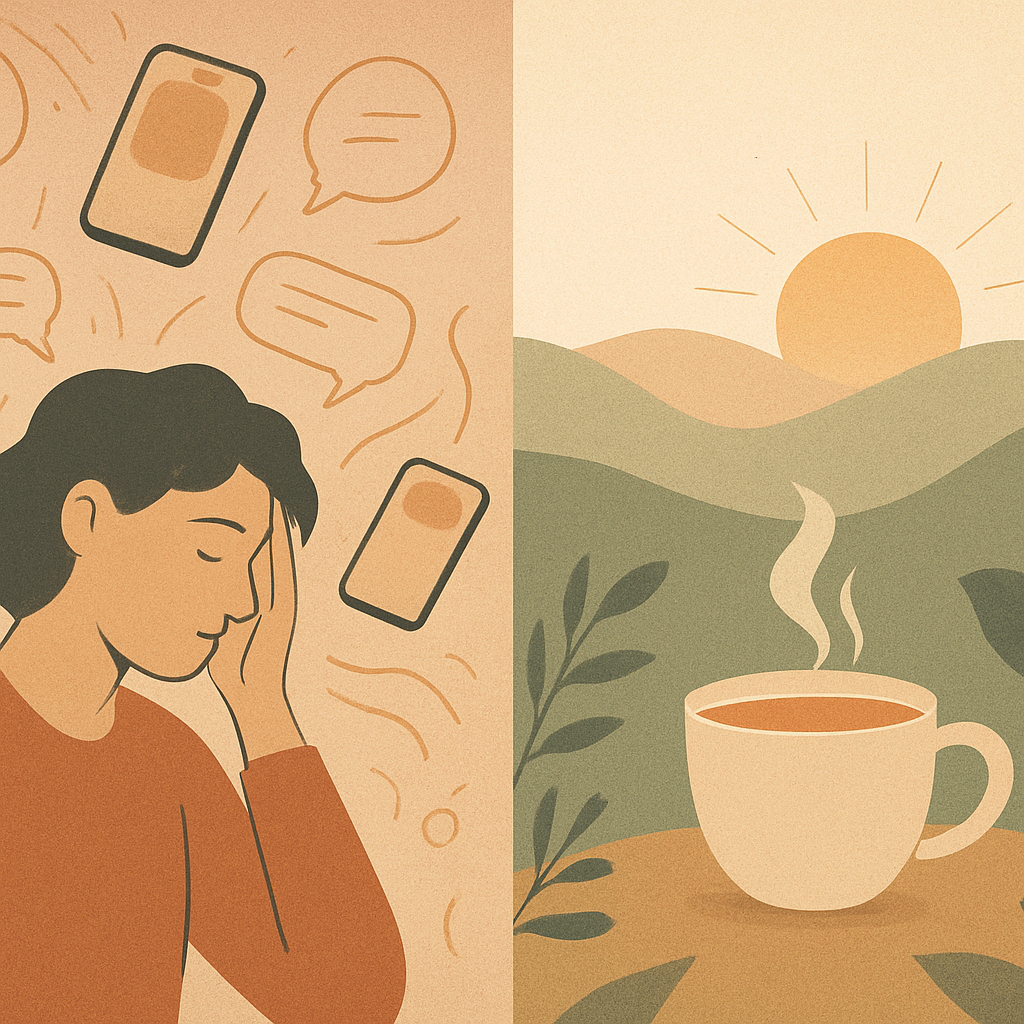
Fight or flight was designed to be rare and brief: a burst of activation, a resolution, and a return to baseline. A deadline, an unread message, a tense email, and a doom-scroll session each produce a smaller version of the same chemistry. Stack enough of them, and your baseline quietly shifts upward. You stop returning to calm. You start living a few notches above it — and calling that "normal."
The nervous system does not measure danger. It measures inputs. And it cannot tell the difference between a genuine threat and a notification badge.
Why modern life overstimulates the nervous system
Ayurveda has a concept that feels almost prophetic given our current devices: indriya, the senses, are the doorways through which the world enters the mind. What you take in through the eyes, ears, and mind becomes mental food. And just as the digestive fire, agni, can be overwhelmed by too much physical food, the mind can be overwhelmed by too much sensory food.
Consider an ordinary morning. Before you have stood up, you have absorbed dozens of headlines, several work messages, two arguments you were not part of, and an algorithmic feed engineered to keep your attention slightly agitated. None of it is digested. It simply accumulates as ama — undigested residue — in the mind. By the time you sit down to actually work, prana vata is already scattered. You are not lazy or undisciplined. You are over-fed and under-digested.
The three biggest amplifiers of nervous system load in modern life are remarkably consistent:
- Speed and switching. Constant task-switching keeps the sympathetic branch primed. Every notification is a micro-startle.
- Irregularity. Vata is governed by rhythm. Irregular meals, sleep, and screen times destabilize it directly.
- Stimulants stacked on depletion. Caffeine on top of poor sleep borrows energy you have not earned, then charges interest in the form of more anxiety.
The Ayurvedic view: prana vata and the senses
In Ayurvedic physiology, Vata is the principle of movement — of breath, nerve impulses, circulation, and thought. Prana vata, seated in the head and chest, governs the mind, the heart, and the act of receiving. When prana vata is smooth and grounded, your attention rests where you place it. When it is aggravated by speed, stimulation, irregularity, and fear, it becomes erratic: racing thoughts, shallow breath, a fluttering chest, difficulty finishing tasks, and the particular tired-but-wired insomnia that so many people describe.
This is why the Ayurvedic approach to calming the nervous system is not primarily about "relaxing." It is about grounding — adding the qualities that Vata lacks. Vata is light, dry, cold, mobile, and subtle. So the antidote is heavy, oily, warm, stable, and grounding. This single principle explains nearly every practice below: warmth, rhythm, weight, oil, and slowness all pull an overstimulated system back toward earth.
If you want to understand your own baseline tendency here, it helps to know your constitution. A Vata-predominant person regulates very differently from a Pitta-predominant one, and you can take the dosha quiz to see where you sit. For the deeper stress picture, the companion piece on the signs of high cortisol covers what chronic activation does to your hormones over time.
A daily nervous system regulation protocol
Regulation is not a single technique you deploy in a crisis. It is a set of small, repeated inputs that lower your baseline so the crises become rarer and smaller. Below is the protocol I come back to, organized by when it happens rather than by how impressive it sounds. None of it is complicated. That is the point — an overstimulated nervous system does not need another demanding project.
Morning: protect the first hour
The first hour sets the tone for prana vata for the entire day. The single highest-leverage change most people can make is to delay the inbound rush. Do not feed the senses before you have grounded them. Drink something warm, feel your feet on the floor, and breathe before you let the world in.
Daytime: interrupt the accumulation
You do not need a thirty-minute meditation. You need three deliberate exhales before each meal and a genuine pause between tasks. The exhale is the lever: a long, slow out-breath is the most direct voluntary access you have to the parasympathetic brake. Make the exhale longer than the inhale and the body interprets it as safety.
Evening: signal the brake
Warmth and oil are the strongest grounding inputs Ayurveda offers. A warm bath, a bowl of cooked food rather than raw, and a few minutes of abhyanga — self-massage with warm sesame oil — tell the nervous system, unambiguously, that the day's demands are over. For the wind-down itself, a calming cup helps; the guide to the best Ayurvedic teas for sleep covers what to reach for.
Your daily regulation checklist
The grounding inputs, ranked
Not every regulating practice is equal. Here is how the main Ayurvedic and physiological tools compare on effort versus impact, so you can choose where to start.
| Practice | Effort | Best for |
|---|---|---|
| Extended exhale breathing | Very low | Acute spikes, in the moment |
| Warm oil foot massage | Low | Evening wind-down, sleep |
| Regular meal and sleep times | Medium | Lowering the baseline over weeks |
| Reducing morning stimulation | Medium | Racing thoughts, scattered focus |
| Daily walk in nature | Medium | Mood, grounding, prana vata |
What to do tomorrow morning
If you only change one thing, change the first hour. Here is the exact sequence to try tomorrow — it takes about ten minutes and asks nothing of you except that you do not reach for your phone first.
- Before you check any screen, sit on the edge of the bed and take ten slow breaths, making each exhale longer than the inhale.
- Drink a glass of warm water — not cold — slowly, while standing or sitting still.
- Put both feet flat on the floor and notice the contact for thirty seconds. This is the entire grounding practice.
- Step outside or to a window for two minutes of natural morning light before you open your inbox.
That is it. You are not trying to achieve a state. You are simply giving prana vata a calm, rhythmic, grounded start before the day's stimulation begins. Do this for one week and notice whether your afternoons feel different.
Common mistakes
Most people who try to calm their nervous system make one of a handful of predictable errors. They are worth naming, because avoiding them is often more powerful than adding another technique.
- Treating regulation as a crisis tool only. Breathing exercises used only during panic work far less well than the same exercises used daily when you are calm. You are training a baseline, not performing a rescue.
- Stacking stimulation onto depletion. More caffeine to push through tiredness keeps the accelerator floored. Address the sleep debt instead.
- Going cold and raw. Cold smoothies, raw salads, and iced drinks aggravate Vata further. Warm, cooked, and oily is the grounding direction.
- Chasing intensity. A punishing workout can spike an already activated system. For an overstimulated nervous system, walking and gentle movement often regulate better than high-intensity training.
- Expecting it overnight. The nervous system shifts its baseline over weeks of consistent input, not in a single dramatic session.
For the bigger picture on how chronic activation turns into exhaustion — and how to climb back out — the guide on why you feel tired all the time picks up exactly where this one leaves off.
FAQ
How long does it take to calm an overactive nervous system?
Acute techniques like extended-exhale breathing work within minutes. Shifting your underlying baseline — so you are not living in low-grade activation — typically takes two to six weeks of consistent daily grounding practices like regular sleep, warm food, and reduced morning stimulation.
Is nervous system dysregulation the same as anxiety?
They overlap but are not identical. Anxiety is one possible expression of a dysregulated nervous system, but chronic activation can also show up as insomnia, digestive issues, irritability, or fatigue without obvious worry. Ayurveda would describe the shared root as aggravated prana vata.
Can diet really affect the nervous system?
Yes. In Ayurveda, the qualities of your food directly influence Vata. Cold, dry, and raw foods tend to aggravate an already light, mobile nervous system, while warm, cooked, lightly oily foods are grounding. Regular meal timing matters as much as the food itself.
What is the single most effective practice?
For most people, protecting the first hour of the morning from stimulation — no phone, a warm drink, light, and slow breathing — produces the largest shift, because it sets the tone for prana vata across the entire day.