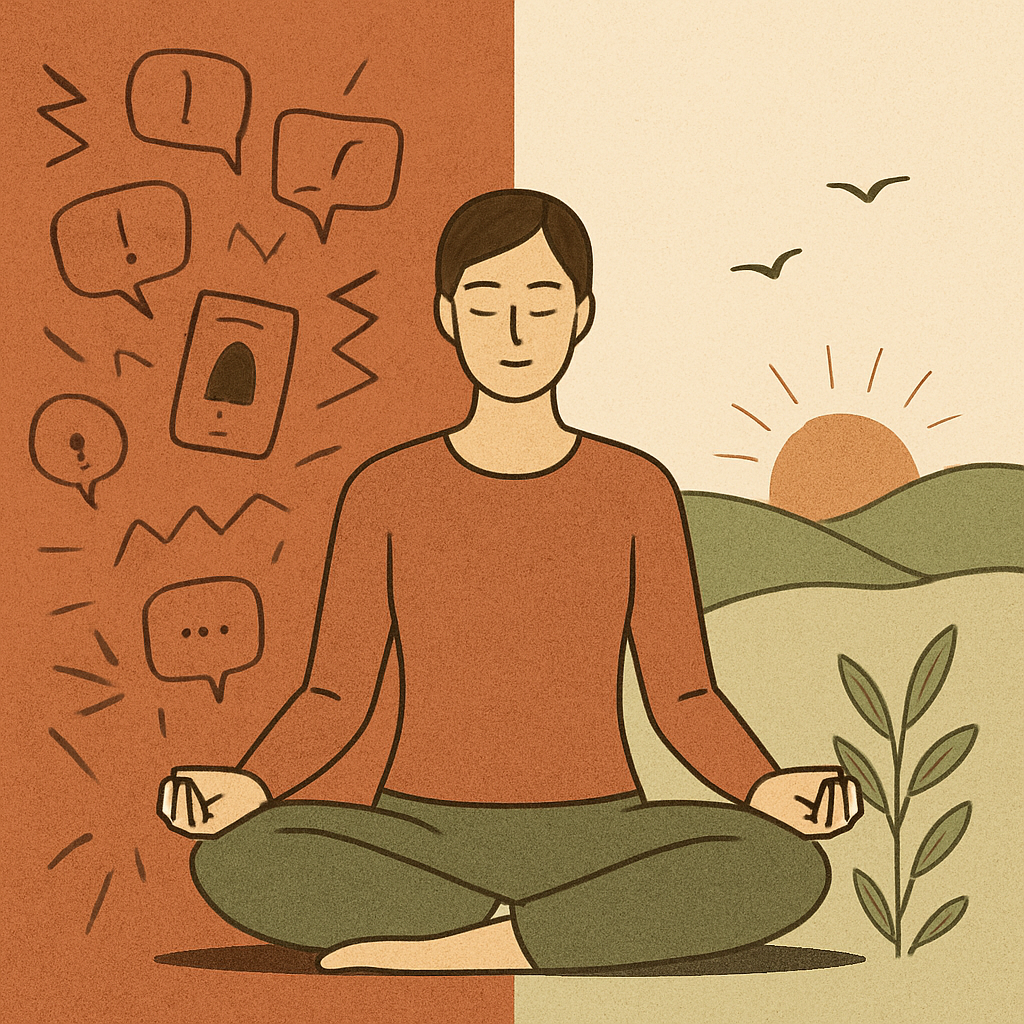
The Body That Forgot How to Feel Safe
Your nervous system has two broad modes. One is the sympathetic state — mobilised, alert, ready to act. The other is the parasympathetic state — the place where digestion, repair, deep sleep, and genuine rest happen. In a healthy rhythm you move fluidly between the two: activated when you need to be, settled the rest of the time. The problem is not that you experience stress. The problem is that you never fully come back down.
What keeps you up there is rarely a single catastrophe. It is the accumulation of dozens of tiny activations — a notification, a headline, a second coffee, an unfinished message, a scroll through other people's highlight reels — none of which is dangerous, all of which the body reads as a small call to attention. The threat never resolves because the next one arrives before the last one clears. Over months and years, the activated state stops feeling like an emergency and starts feeling like your personality.
This is the territory of nervous system burnout: not dramatic collapse, but a slow narrowing of your capacity to feel calm. And the cruel part is that rest itself starts to feel uncomfortable, because a system braced for action interprets stillness as a threat it cannot see.
You do not have an anxiety problem layered on top of a calm baseline. You have lost the baseline. The work is not to manage the anxiety — it is to rebuild the sense of safety underneath it.
The Three Nervous System States
The two-mode picture above can be refined. Modern neuroscience, drawing on polyvagal theory, describes three states rather than two, and Ayurveda maps onto each of them.
Modern neuroscience describes three distinct nervous system states, mapped onto the vagal system. The ventral vagal state is the parasympathetic state of safety — calm alertness, social connection, good digestion, restorative sleep. The sympathetic state is the mobilization response — activation, arousal, energy expenditure, preparation for threat. The dorsal vagal state is the shutdown response — dissociation, numbness, withdrawal, complete immobilization.
Most modern people alternate between sympathetic and dorsal vagal, spending very little time in the ventral vagal state. Work demands activate sympathetic. Evening overwhelm or depression represents dorsal vagal shutdown. Few people experience the baseline safety of sustained ventral vagal activation.
Ayurveda describes this pattern through the lens of Vata and Ojas. Vata is the force of activation and movement. In excess, Vata creates the scattered, anxious, hypervigilant state that characterizes sympathetic overdrive. Ojas is the deepest form of nourishment and resilience — essentially, the resources that allow the nervous system to return to safety. When Ojas is depleted, even small stressors keep you in sympathetic activation or push you into dorsal vagal collapse.
The dorsal state is worth naming because it is easy to mistake for calm. Flatness, numbness, and withdrawal are not rest — they are the system going below activation into shutdown. The route back to safety runs through the same warm, rhythmic, Vata-settling inputs described below, not through more stimulation.
Fight, Flight, and the Ayurvedic View of Vata
Ayurveda organises the body and mind around three functional principles called doshas: Vata (movement, air, the nervous system), Pitta (transformation, fire, metabolism), and Kapha (structure, earth, stability). Every person is a unique blend, but the dosha most relevant to the modern nervous system is Vata. Its qualities are dry, light, cold, mobile, subtle, and quick — and so is an overstimulated mind. Racing thoughts, restlessness, difficulty settling, a feeling of being scattered, cold hands, shallow breath, and that wired-but-tired exhaustion are, in Ayurvedic terms, classic signs of aggravated Vata.
The insight that makes Ayurveda useful here is that like increases like. If Vata is already high and you fill your day with more movement, more speed, more stimulation, more cold, more irregularity — you do not discharge the tension, you amplify it. Most modern advice for stress makes this mistake. It adds: more tracking, more optimisation, more intense exercise, more cold exposure, more inputs. Ayurveda does the opposite. To calm a system defined by movement and speed, you introduce the qualities it lacks — warmth, weight, oil, slowness, rhythm, and quiet.
If you are new to all of this, the honest beginner's guide to Ayurveda is the gentlest place to start, and the free dosha quiz will tell you whether Vata is in fact your dominant pattern. Most people who feel chronically unsafe in their own body are dealing with elevated Vata regardless of their underlying constitution.
The Four Modern Habits Keeping You Activated
Four everyday habits do most of the damage. None of them is evil, and you do not have to eliminate them entirely. But if your nervous system never feels safe, these are the levers that matter most.
Doomscrolling keeps the threat-detection system permanently on. The content is emotionally charged, the format is fast and fragmented, and the lack of an ending means your brain never receives the all-clear. First thing in the morning and last thing at night are the worst times for it — you are programming your nervous system for the hours that matter most.
Caffeine is a direct chemical instruction to stay alert. For some constitutions, in modest amounts, it is fine. But if you are already wired, coffee is pouring accelerant on a fire and then wondering why you feel anxious. It also blocks the adenosine that should be making you sleepy, which is why the afternoon cup quietly wrecks the night's sleep. If coffee is non-negotiable for you, the piece on Ayurveda and coffee covers how to make it less aggravating rather than quitting outright.
Alcohol feels like relaxation because it sedates. But sedation is not regulation. A drink switches off the alarm temporarily and then, as it metabolises overnight, produces a rebound surge of activation — which is exactly why you wake at 3am with a racing heart after an evening of drinking. The mechanics of that early-morning wake-up are covered in why you wake up at 3am, and the broader effect is in Ayurveda and alcohol.
Overstimulation is the quiet one — the background hum of podcasts during every walk, music in every gap, a screen at every meal, a second tab during every video. The nervous system has no empty space in which to settle. Silence and boredom are not problems to be solved; they are the conditions under which the body finally registers that nothing is wrong.
You cannot supplement your way out of a lifestyle that keeps you activated. No herb, no adaptogen, no breathing app survives contact with a day built on speed, caffeine, and the infinite scroll.
How Ayurveda Helps the Nervous System Stand Down
The Ayurvedic approach is not a single technique but a set of conditions that, applied consistently, persuade the body it is safe. The watchwords are warm, slow, heavy, oily, and rhythmic — the precise opposites of the Vata qualities that keep you wired.
Rhythm comes first. The nervous system trusts predictability above almost everything else. Eating, sleeping, and waking at roughly the same times each day gives the body a reliable scaffold, and reliability is what safety feels like at the physiological level. A consistent, unhurried morning routine sets the tone for the whole day; an early, calm wind-down protects the night.
Warmth and oil come next. Warm cooked food rather than cold and raw, warm drinks rather than iced, and the practice of abhyanga — massaging warm oil into the skin, especially the feet, before bed — all deliver the grounding, weighting qualities Vata lacks. The skin is the largest organ of the nervous system, and slow, warm, oily touch is a direct signal of safety.
Breath and slowness finish it. Long, slow exhales are the most reliable manual override for the parasympathetic system; making the out-breath longer than the in-breath tells the body, in its own chemical language, that the danger has passed. Specific calming herbs such as ashwagandha and brahmi are traditionally used to support this work — the guide to the best herbs for anxiety and the deep dive on ashwagandha cover who they suit and who should be cautious. Herbs are support, not substitute; they work only on top of a calmer life.
If your sleep is the part that has collapsed — and for most overstimulated people it is — the protocols in Ayurveda for insomnia and the best Ayurvedic tea for sleep are the natural next step, because a regulated nervous system and good sleep build each other.
What to Do Tomorrow Morning
You do not need to overhaul your life. You need to change the first ninety minutes of your day, because those minutes set the nervous system's baseline for everything that follows. Try this tomorrow:
- Leave your phone face-down and untouched for the first thirty minutes after waking. No feed, no email, no headlines before your own mind has come online.
- Drink a glass of warm water before anything else — warm, not cold, to gently wake digestion without shocking the system.
- Delay caffeine until at least an hour after waking, and eat something warm first so it does not hit an empty, activated stomach.
- Take three minutes of slow breathing with the exhale longer than the inhale — in for four, out for six or eight.
- Step outside into natural daylight for a few minutes; morning light anchors your circadian rhythm, which anchors everything else.
- Do one thing slowly and on purpose — make tea, stretch, walk — without a podcast, without music, without a second input.
Done consistently for a couple of weeks, this is often enough to feel a measurable shift. It is not dramatic. Regulation never is.
Common Mistakes
Most people sabotage their own recovery in predictable ways. Watch for these:
- Treating rest like another performance. Optimising your relaxation with trackers, scores, and metrics keeps the alert mind in charge. Rest cannot be measured into existence.
- Adding intensity to discharge stress. Punishing workouts and aggressive cold plunges can further aggravate an already high-Vata system. Movement should be grounding more often than depleting — see Ayurveda and exercise.
- Reaching for the herb before changing the habit. Adaptogens layered on top of caffeine, alcohol, and doomscrolling cannot win that fight.
- Expecting it fast. A nervous system trained over years into alertness needs weeks of consistent, boring safety signals before it trusts the change. Impatience is itself a Vata trait.
- Going cold turkey on everything at once. Removing all stimulation overnight tends to backfire. Change one input at a time and let the body adjust.
If you want to understand which of these patterns is most yours, the dosha quiz is the fastest way to see your constitution, and the Vata dosha guide goes deeper on the specific imbalance behind a nervous system that never feels safe. The goal is not to become someone who never feels stress. It is to become someone whose body knows, reliably, how to come back down.
Nervous system regulation looks different for each dosha, so a plan that fits your constitution works faster. Take the free dosha quiz to find your type and get a regulation routine matched to it.
Frequently asked questions
What does nervous system regulation mean in Ayurveda?
In Ayurveda, a dysregulated nervous system is usually aggravated Vata, the principle of movement and speed. Regulation means bringing Vata back into balance with warmth, routine, grounding food and slower rhythms so the body can feel safe again.
Why does my nervous system never feel safe even when nothing is wrong?
Chronic stress keeps the sympathetic branch switched on, so the body stays braced for threat out of habit rather than real danger. The fix is repeated signals of safety, not willpower.
How do you calm an overactive nervous system naturally?
Anchor the day with regular meals and sleep, get morning light, use slow exhale-led breathing, and warm oil self-massage. These consistently downshift the stress response over a few weeks.
How long does it take to regulate the nervous system?
Small shifts in sleep and calm often appear within two to three weeks of consistent routine, while deeper resilience rebuilds over two to three months.
This article is educational wellness information, not medical advice. If you experience persistent anxiety, panic, or symptoms that interfere with daily life, please consult a qualified healthcare professional.